
Dual Occupancy Canberra can help with the design, the planning approvals and the construction of any of the options below — or pick a project up part-way, at whichever of those stages you have reached.
The five are not the same thing, and the words for them get used loosely. Here is what each one actually means, and what decides whether it is open to you.
Extension
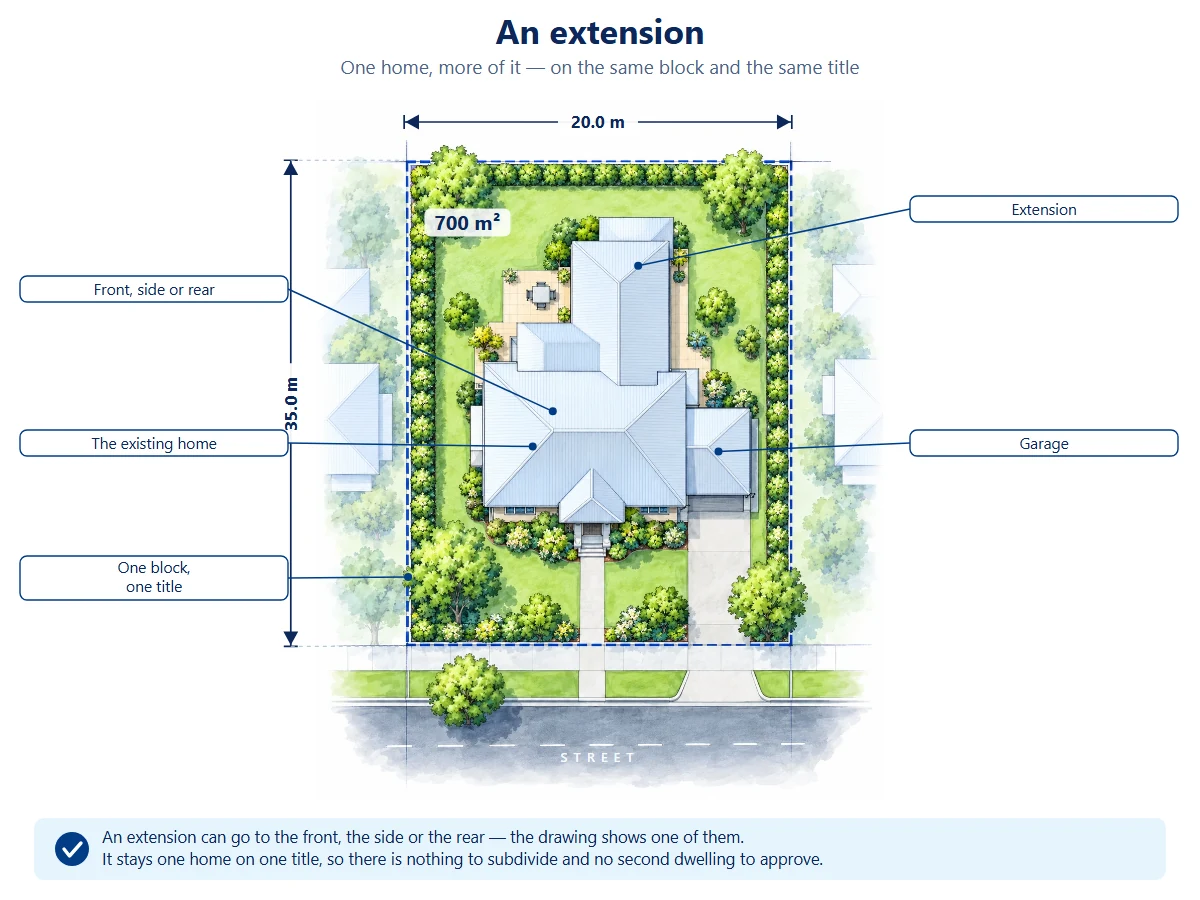
One home, more of it.
The land keeps being used for a single dwelling, so the rules stay the simplest of the five. How much you can add is governed by site coverage: on a large block the buildings may cover up to 40% of it, and on a mid-sized block up to 60%. In RZ1 and RZ2 you may build to two storeys.
Site coverage counts everything roofed — the house, a Secondary Residence if you have one, the garage, the carport.
Questions people ask about this
Secondary Residence
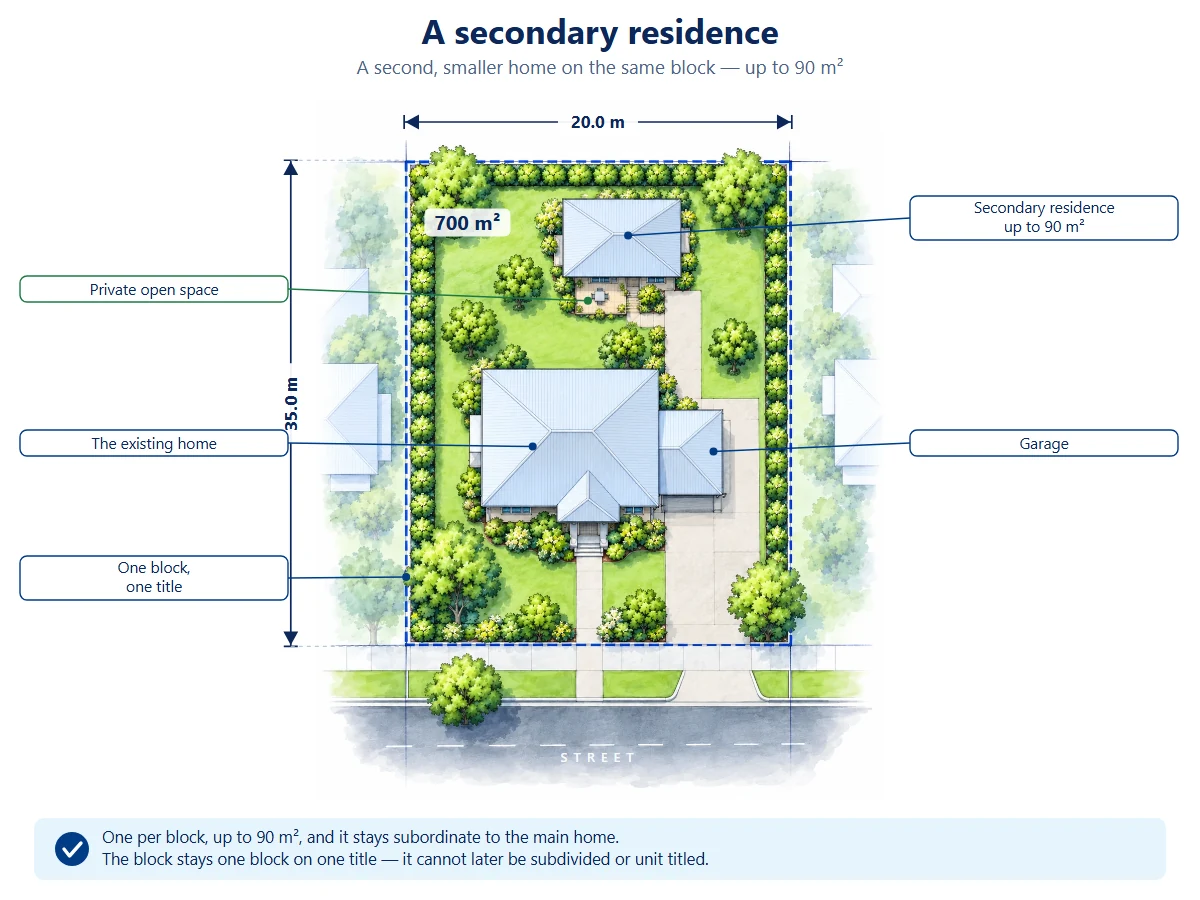
A second, smaller home on the same block as the principal one.
One per block, and its dwelling size must not exceed 90 m². That is measured to the outside face of the external walls and excludes the garage — which is not the same as gross floor area, and matters when a design sits close to the limit.
The block stays one block and the title stays one title. A Secondary Residence does not, by itself, make the second home separately saleable. Two storeys in both RZ1 and RZ2.
Questions people ask about this
Sub Divide your block
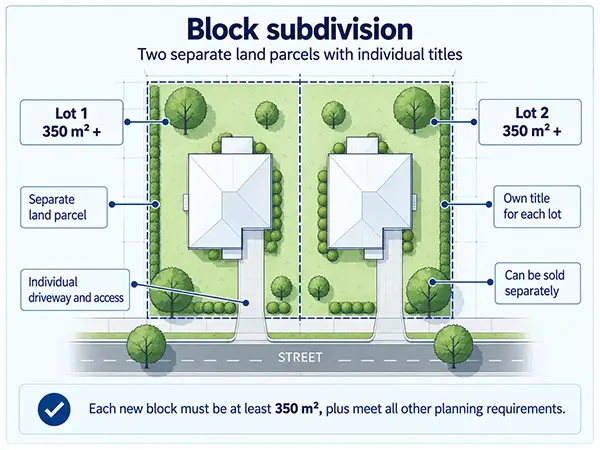
One block becomes two or more, each with its own Crown lease.
This is the option that creates genuinely separate pieces of land. Where a new block is created before a house is built on it, its Crown lease may require a dwelling to be constructed within a set time.
Site coverage on blocks created this way is capped at 45% in RZ1 and RZ2 — tighter than the 60% a mid-sized block would otherwise allow, which is worth knowing before the maths is done on a subdivided lot.
A fence, a separate driveway or a second dwelling does not subdivide land. Only the formal surveying and registration process does.
Questions people ask about this
Unit Title
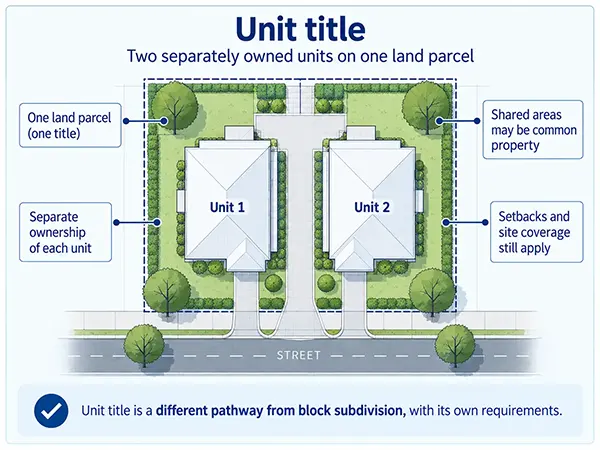
Separate titles for homes that sit on one block.
This is how two dwellings become separately saleable without splitting the land underneath them. It is assessed after the build, not before: a licensed unit title assessor inspects the finished development and reports whether it was built in accordance with the approved plans and the development approval.
It is a different question from what you are allowed to build. A development can be approved, built and finished and still need this step before either home can be sold on its own.
Questions people ask about this
Multi Occupancy Housing
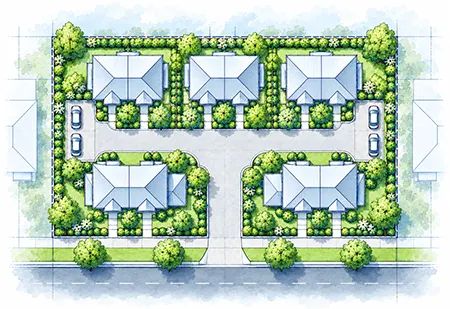
More than one dwelling on the land.
It starts at two — a dual occupancy is multi occupancy housing, and so are townhouses and apartments. The moment there is a second dwelling, the development is assessed against a different set of rules from a single home, with different setbacks and different design requirements.
It stays on one title. Multi occupancy housing is about how many homes are on the land, not about who owns what. Build two and you still have one block on one Crown lease — so the homes cannot be sold separately, and a lender sees the whole thing as one asset. Making them separately saleable is a second, separate step: Unit Title keeps the land whole and gives each home its own title, or Sub Divide splits the land itself. Neither happens on its own.
Site coverage is 45% of the original block area in both RZ1 and RZ2. Height is where the two zones part company: RZ1 allows two storeys, RZ2 allows three.
Questions people ask about this
What decides which of these is open to you
Five things, and only one of them is about what you want to build:
- What you are proposing — the five options above are assessed differently
- The size of your block
- Its zone — RZ1 Suburban, or RZ2 Suburban Density
- The district it sits in, which can carry its own controls
- When the subdivision your block belongs to was approved
That last one catches people out. The same house on the same sized block can face a different front setback depending on the year its subdivision was signed off.
Check My Block reads those facts from ACT Government data for your address and tells you which of these look possible.
This page explains the options in general terms. It is not planning advice for a particular block — confirm the position for your property before relying on it.