









Find answer to your planning questions

Popular Planning Questions
Showing 91-96 of 176 planning questions
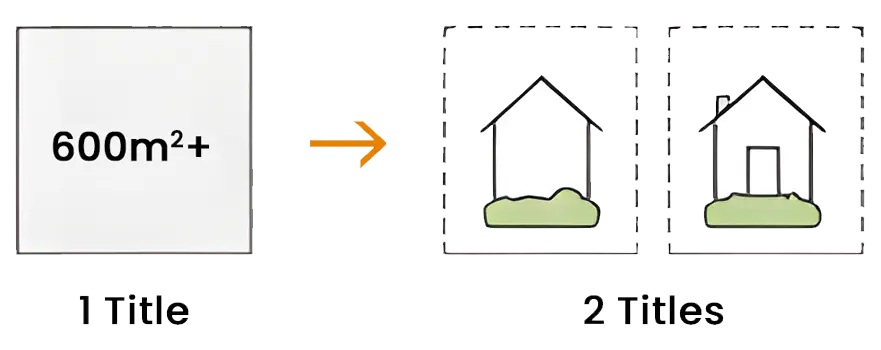
No. Building or obtaining approval for a dual occupancy does not automatically mean the two dwellings qualify for separate titles.
Creating separate unit titles involves a unit title subdivision, which must separately comply with the applicable Territory Plan subdivision requirements and the Unit Titles Act 2001.
Whether separate titles can be obtained therefore depends on whether the particular dual occupancy satisfies those requirements.
Reference: Territory Plan 2023 (NI2023-540), Part F1 – Subdivision Policy – https://www.legislation.act.gov.au/ni/2023-540/Current
Last reviewed 2 September 2026
A Development Approval (DA) generally remains valid for 5 years from the date the approval takes effect.
An application may be made to extend the approval period, subject to meeting the applicable requirements.
Reference: Planning Act 2023 – Development Approval duration and extension provisions; ACT Government – Possible Outcomes – When DA Approval Expires – https://www.planning.act.gov.au/applications-and-assessments/development-applications/after-you-apply/possible-outcomes
Last reviewed 2 September 2026
For a standard dual-occupancy Development Application, the statutory decision timeframe is generally 30 working days if no representations (public comments or objections) are received, or 45 working days if representations are received.
Before assessment starts, ACT Planning also undertakes a completeness check, which it aims to complete within 5–10 working days. The overall process can take longer if further information is requested, the proposal is amended, or pre-decision advice is issued, as these can pause or restart the statutory timeframe.
Reference: ACT Government – After You Apply → Approval Timeframes – https://www.planning.act.gov.au/applications-and-assessments/development-applications/after-you-apply
Last reviewed 2 September 2026
Yes. A dual occupancy can be designed on a battle-axe block, subject to meeting the applicable planning requirements.
The ACT Missing Middle Housing Design Guide specifically provides an example of a dual occupancy on a battle-axe block. In the example, the block also fronts public open space, and the dwellings are positioned to provide front gardens and direct access to the public open space, supporting activation and passive surveillance
Whether a particular battle-axe block can accommodate a dual occupancy will still depend on the site’s circumstances and compliance with the applicable Territory Plan requirements.
Reference: ACT Missing Middle Housing Design Guide – Site and Land Use → Irregular Blocks – https://www.planning.act.gov.au/__data/assets/pdf_file/0020/3092411/ACT-Missing-Middle-Housing-Design-Guide.pdf
Last reviewed 2 September 2026
Yes. A dual occupancy adjoining public open space may be subject to specific planning requirements, particularly setback requirements for boundaries adjoining public open space.
In addition, the Missing Middle Housing Design Guide recommends designing the development to create a positive relationship with the open space, including landscaping, passive surveillance, appropriate privacy and minimising overshadowing.
The exact requirements depend on the block, zone, building height and the particular boundary adjoining the public open space.
Reference: Planning (Residential Zones) Technical Specifications 2026 (NI2026-303) – https://www.legislation.act.gov.au/View/ni/2026-303/current/PDF/2026-303.PDF & ACT Missing Middle Housing Design Guide – ACT Missing Middle Housing Design Guide
Last reviewed 4 September 2026
Yes, potentially. A dual occupancy can be built in a Bushfire Prone Area (BPA), but additional bushfire planning and construction requirements apply.
The ACT Bushfire Management Standards apply to all development within a mapped Bushfire Prone Area, including residential development. The proposal must respond to the site’s bushfire risk and incorporate the applicable Bushfire Protection Measures, which may include building separation and defendable space, appropriate emergency access and egress, construction standards, services and vegetation/fuel management.
Being in a Bushfire Prone Area therefore does not automatically prohibit a dual occupancy, but the development must satisfy the applicable bushfire requirements.
Reference Emergencies Bushfire Management Standards 2025 (NI2025-265) – https://www.legislation.act.gov.au/View/ni/2025-265/current/html/2025-265.html
Last reviewed 4 September 2026
General information only. Not legal or planning advice. Always refer to the Territory Plan
and seek professional advice for your specific situation.
 Planning Definitions