









Find answer to your planning questions

Popular Planning Questions
Showing 67-72 of 176 planning questions
How much of your block you can build on depends on the block type, residential zone and type of development.
For a single dwelling or a dwelling with a secondary residence (granny flat), the maximum site coverage is generally 40% for a large block, 60% for a mid-sized block and 70% for a compact block. The main house, secondary residence and relevant roofed structures are considered together when calculating site coverage.
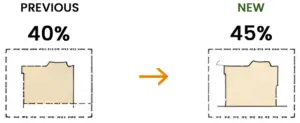
For a dual occupancy, which is treated as multi-unit housing for these requirements, the maximum site coverage is generally 45% in RZ1 and RZ2 and 50% in RZ3, RZ4 and RZ5.
Other planning requirements, such as setbacks, private open space, planting and building height, may further limit how much of the block can actually be developed.
Reference: Territory Plan 2023 (NI2023-540), Residential Zones Policy, Assessment Requirements 7 and 8 (Site Coverage) – Territory Plan 2023 | Notifiable instruments
Last reviewed 4 September 2026
Yes, potentially. A dual occupancy may be possible on a property in a heritage area if it is permitted under the applicable ACT planning rules. However, the proposal must also address the property’s heritage significance.
If the property is heritage-listed or within a heritage precinct, the design may need to minimise impacts on important heritage features and character. This can affect the location, scale, appearance, landscaping and treatment of existing buildings.
The applicable Heritage Register citation and heritage guidelines should also be checked for the particular property or precinct.
Reference:
Territory Plan 2023 – Part E01 Residential Zone Policy – Territory Plan 2023 | Notifiable instruments
Heritage Act 2004 – Part 10, s 61; Applicable Heritage Register citation and Heritage Guidelines – https://www.legislation.act.gov.au/View/a/2004-57/current/html/2004-57.html
Last reviewed 4 September 2026
No. The two dwellings in a dual occupancy do not need to be the same size. One dwelling can be larger than the other.
The current ACT planning requirements do not generally require equal dwelling sizes. However, the overall development must comply with the applicable requirements, including site coverage, setbacks, building height, private open space, planting, parking and access. These controls may affect how large each dwelling can be.
Reference: Planning (Missing Middle Housing) Design Guide 2026 – ACT Missing Middle Housing Design
Last reviewed 4 September 2026
You can check what you are allowed to build by looking at your Crown lease, especially the purpose clause. It tells you how the land can be used and may say how many dwellings are allowed.
You should also check the ACT Territory Plan for the planning rules that apply to your block. If your Crown lease does not allow your proposed development, you may need to change (vary) the Crown lease.
Reference: Planning Act 2023 (A2023-18), Clause 276 – Use of Land for Leased Purpose – https://www.legislation.act.gov.au/View/a/2023-18/current/html/2023-18.html
Last reviewed 4 September 2026
For a dual occupancy, the maximum site coverage is generally 45% of the original block area in RZ1 and RZ2, and 50% in RZ3, RZ4 and RZ5.
There is no separate maximum floor area specified for each individual dwelling. Instead, the size of the two dwellings is determined by the overall site coverage and other requirements such as setbacks, building height, private open space and landscaping.
Reference: Territory Plan 2023 (NI2023-540), Residential Zones Policy, Assessment Requirements 8 (Site Coverage) – Territory Plan 2023 | Notifiable instruments
Last reviewed 4 September 2026
Yes, potentially. The ACT Missing Middle Housing Design Guide specifically illustrates dual occupancy development where the existing dwelling is retained and a second dwelling is added. The completed development must still comply with the applicable Residential Zones Policy requirements, including site coverage, setbacks, private open space, planting, parking and access.
Reference: Planning (Missing Middle Housing) Design Guide 2026 – ACT Missing Middle Housing Design Guide & Territory Plan 2023 – Part E01 Residential Zone Policy – Territory Plan 2023 | Notifiable instruments
Last reviewed 4 September 2026
General information only. Not legal or planning advice. Always refer to the Territory Plan
and seek professional advice for your specific situation.
 Planning Definitions