









Find answer to your planning questions

Popular Planning Questions
Showing 61-66 of 176 planning questions
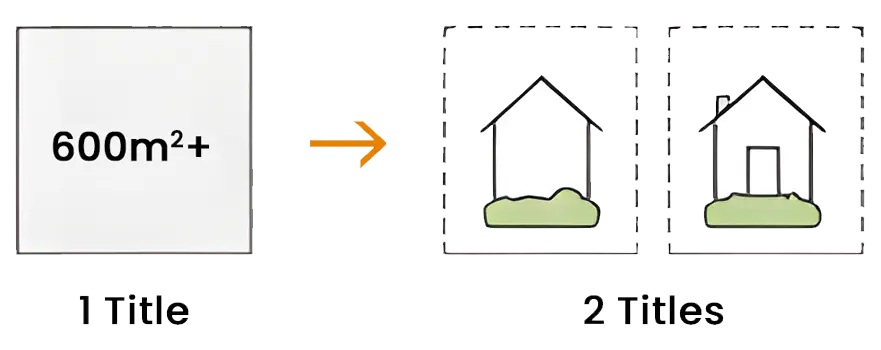
A block subdivision involves dividing one block of land into two or more separate blocks. Each resulting block receives its own Crown lease. If a new block is created without a dwelling, the Crown lease may include requirements about future development, such as constructing a dwelling within a specified timeframe. Block subdivision focuses on creating separate parcels of land rather than separating individual dwellings. A unit title subdivision involves dividing an existing development, such as a dual occupancy, townhouse development, or apartment building, into separately titled units. The land remains under one Crown lease, but individual units are created as separate titles. Before a unit title subdivision can occur, the development generally needs to be completed and have a Certificate of Occupancy and Use. Unit title subdivisions also include common property, such as shared driveways, gardens, or other shared areas, which are managed by an owners corporation.
In simple terms, a block subdivision creates separate parcels of land, with each new block receiving its own Crown lease. In contrast, a unit title subdivision creates separate ownership of dwellings within an existing development while the land remains under a single Crown lease and shared areas are managed as common property. The distinction is important because the two subdivision types have different legal requirements, approval processes, and ownership arrangements, so understanding which applies determines how the property can be developed, titled, and managed.
Last reviewed 4 September 2026
There are two subdivision options to consider if you already have a house on your block and want to create separate ownership. However, the option that applies depends on whether you want to create a new block of land or separate units within the existing block.
Option 1 – Block subdivision (applicable if you want to create and sell a vacant block)
A block subdivision may be possible if your existing block can be divided into two separate blocks that meet the Territory Plan requirements. The Development Application must show that each new block can support a compliant dwelling. If approved, the new vacant block can receive its own Crown lease and may be sold separately. However, if the new block is undeveloped, the new Crown lease may include requirements to build a dwelling, and approval from the Minister may be needed before transferring the block if the dwelling has not been constructed.
Option 2 – Unit title subdivision (generally not applicable if you only want to sell a vacant block)
Unit title subdivision does not create a new block of land. Instead, it creates separate ownership of dwellings within the same block. This option is generally used where there are multiple dwellings (such as a dual occupancy) that have been lawfully constructed and are intended to be sold as separate units. It would not allow you to sell an empty piece of land separately.
For your situation (one existing house and the goal of selling a new vacant lot), block subdivision is the relevant pathway to investigate. The ability to proceed will depend on the block’s zoning, minimum block size, access, servicing, lease conditions, and other Territory Plan requirements.
Reference:
Last reviewed 4 September 2026
An undeveloped subdivided block is generally subject to a building and development covenant, requiring construction to commence within 12 months and be completed within 24 months of the lease commencing. If the lessee has not complied with these requirements, they must obtain consent to transfer the Crown lease from the Territory Planning Authority before transferring the block.
To obtain approval, the applicant must submit the appropriate consent to transfer application (either for a first transfer or a second/subsequent transfer), together with all required supporting documents and any applicable fees. The application is assessed by the Territory Planning Authority under the Planning Act 2023 and the Planning (General) Regulation 2023.
Approval may be granted where:
- the proposed transferee intends to comply with the building and development provision;
- any required security has been provided;
- the lessee cannot comply because of financial circumstances;
- the purchaser has contracted a builder to construct the dwelling;
- the lessee has obtained a certificate of compliance; or
- the transfer is the first sale of an undeveloped block by the estate developer.
If consent is refused, the decision may be appealed to the ACT Civil and Administrative Tribunal (ACAT).
Reference: ACT- Changes to a Crown lease – City and Environment Directorate – Planning
Last reviewed 4 September 2026
The process is not simply an application asking the government to reduce an existing LVC assessment. The ACT Government specifies the following process:
- The ACT Government will calculate how much Lease Variation Charge (LVC) you need to pay and send you a Notice of Assessment.
- Defer paying the LVC.
Instead of paying the LVC straight away, you enter the LVC Deferred Payment Scheme. This allows you to postpone the payment while you complete the development. - Finish the development on time.
You need to complete all the dwellings and obtain the required Certificate of Occupancy and Use by 31 December 2030. - Get the reduction and pay the remaining LVC.
Once you meet the requirements and exit the Deferred Payment Scheme, the eligible reduction is applied to your LVC. You then pay the reduced amount instead of the full charge.
Reference: Lease Variation Charge reduction for missing middle development – ACT Government
Last reviewed 2 September 2026
No. You do not need to split your land into separate blocks to create a dual occupancy. You can build the two dwellings first and, if eligible, create separate unit titles so each dwelling can be owned or sold separately.
Last reviewed 4 September 2026
Yes. Once the two homes are built and approved, you may be able to create separate unit titles so each home can have its own owner. The land does not need to be split into separate blocks — instead, each dwelling becomes a separate unit within the same development.
Reference: ACT Government – Advisory Note 19: Block Subdivision versus Unit Title Subdivision in Residential Zones –Block Subdivision vs Unit Title Subdivision (Residential Zones)
Last reviewed 4 September 2026
General information only. Not legal or planning advice. Always refer to the Territory Plan
and seek professional advice for your specific situation.
 Planning Definitions